
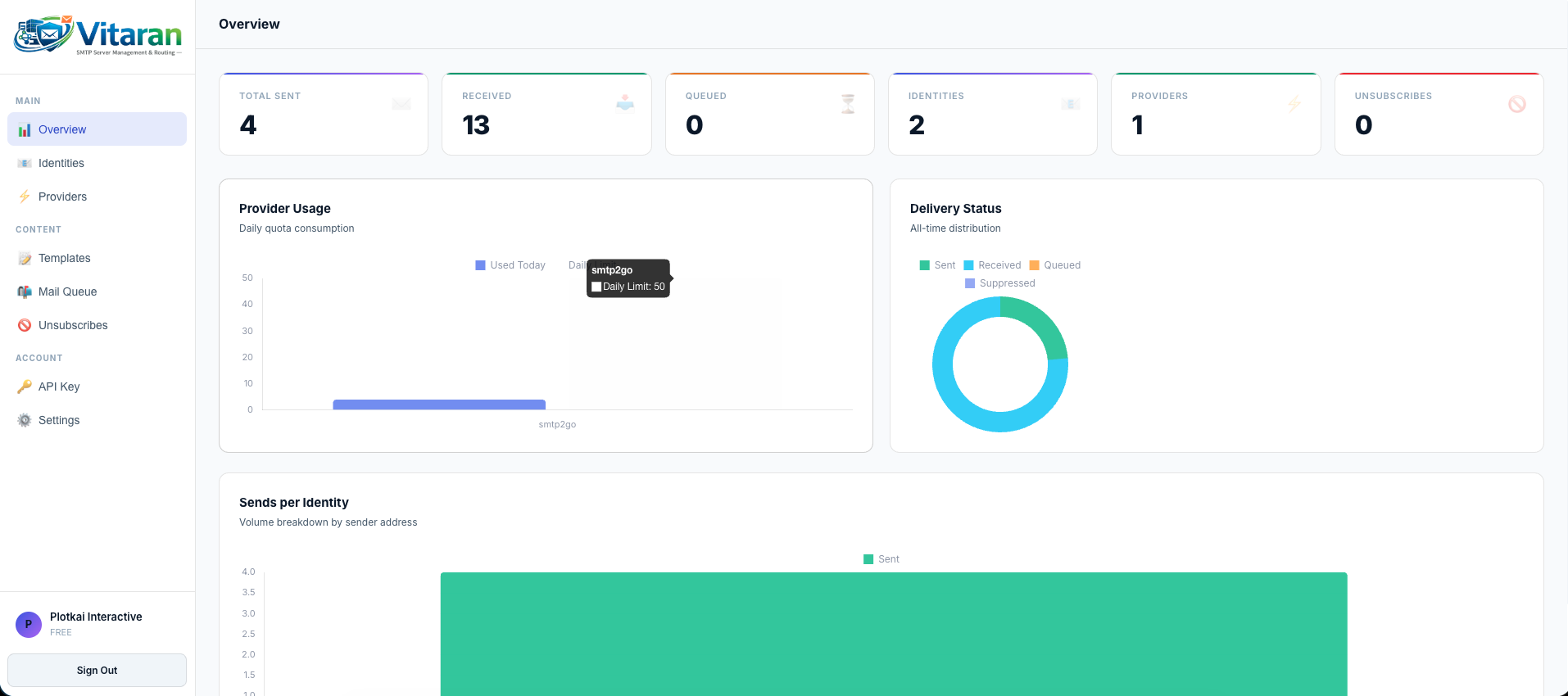
Overview
Vitaran is an operational communication gateway that acts as the central control plane for your entire application ecosystem’s email infrastructure. By serving as a programmable middleware layer between your application logic and multiple third-party email providers (such as SMTP2GO or Brevo, etc), Vitaran eliminates infrastructure fragmentation. It empowers developers to seamlessly manage global user consent, maintain brand-consistent HTML templates, and dispatch cross-channel messages through a single, unified API.
Vitaran goes beyond merely sending emails; it handles bidirectional traffic. By linking outgoing transactional emails with incoming replies via an integrated Cloudflare-powered broker, Vitaran provides granular observability and compliance-as-code. This allows you to easily manage communication reputation and infrastructure across multiple disparate projects without the complexity of configuring distinct setups for each one.
Core Features
- Unified API Gateway: Send emails through a single, standardized REST API regardless of the underlying SMTP provider.
- Provider Load Balancing: Configure multiple SMTP providers with daily usage limits and dynamic weighting to ensure reliable delivery.
- Template Management: Store and manage brand-consistent HTML templates with full Go template variable support.
- Identity & Compliance Control: Manage sender identities, configure 1x1 tracking pixels, enforce SMTP tracing, and handle global unsubscribes with automatic footer injection.
- Bidirectional Email Broker: Ingest inbound emails via Cloudflare Workers to capture replies directly within the dashboard.
- Modern Dashboard: A fully responsive, dark/light mode UI to visualize usage statistics, inspect mail queues, manage providers, and preview templates.
Inbound Emails (Cloudflare Worker Setup)
To capture incoming emails and route them back to Vitaran, you can deploy a Cloudflare Worker using the Cloudflare Email Routing feature.
export default {
  async email(message, env, ctx) {
    // 1. Get the full raw email content
    const rawEmail = await new Response(message.raw).text();

    // 2. Prepare the payload exactly as the API expects
    const payload = {
      from: message.from,
      to: message.to,
      subject: message.headers.get("subject") || "(No Subject)",
      body: rawEmail // This is the entire raw email stream
    };

    // 3. Send to the Vitaran Backend
    const response = await fetch("https://vitaran.your-company.com/api/v1/receive", {
      method: "POST",
      headers: {
        "X-API-Key": env.API_KEY, // Set this in Worker Settings > Variables
        "Content-Type": "application/json"
      },
      body: JSON.stringify(payload)
    });
  }
};
Sending Emails (API)
To send an email through Vitaran from your applications, you must use the POST /api/v1/send endpoint.
Obtaining your API Key
- Log in to the Vitaran Dashboard.
- Navigate to the API Key section in the sidebar.
- If you haven’t saved your key, click Regenerate Key (Note: this immediately invalidates your old key).
- Copy the generated key.
API Usage Example
Include the copied key in the X-API-Key header of your requests.
curl -X POST https://vitaran.your-company.com/api/v1/send \
  -H "X-API-Key: vt_your_key_here" \
  -H "Content-Type: application/json" \
  -d '{
    "from": "<identity_id_from_dashboard>",
    "to": "[email protected]",
    "template_slug": "welcome",
    "vars": {
      "name": "Alice",
      "company": "Acme Corp"
    }
  }'
Payload Fields:
from: The ID of the Identity you configured in the dashboard.to: The email address of the recipient.template_slug: The slug of the HTML template you wish to use.vars: A JSON object of variables that will be injected into the Go template during rendering.
Let's Engineer Your Scalable Mailer
Is your engineering team struggling to design a fault-tolerant mailer infrastructure, optimize SMTP workflows, handle sudden traffic load spikes, or maintain compliance across projects? Let our system design and cloud architects perform a comprehensive Free Email Infrastructure Audit.